

The information has been validated





























 Ireland
Access to procedures and non-refoulement - Ireland
Access to procedures and non-refoulement - Ireland
Overview
Content updated and validated on: 22/08/2025
Relevant EU legislation
Ireland is bound by the recast Asylum Procedures Directive and has transposed its provisions through the International Protection Act 2015.
National legislation
Competent authority and stakeholders
| Area | Competent national authority | Assistance to competent authority (if applicable) |
|---|---|---|
| Screening at the external border | Garda National Immigration Bureau (GNIB) | An Garda Siochana Oifig Inimirce Border Management Unit, DOJHAM | International Protection Office (IPO) | An Oifig Um Chosaint Idirnáisiúnta Border Management Unit (BMU) | An tAonad Bainistíochta Teorann |
| Biometric data | International Protection Office (IPO) | An Oifig Um Chosaint Idirnáisiúnta Border Management Unit, DOJHAM Garda National Immigration Bureau (GNIB) | An Garda Siochana Oifig Inimirce | Border Management Unit (BMU) | An tAonad Bainistíochta Teorann |
| Making an application | At the border: Garda National Immigration Bureau (GNIB) | An Garda Siochana Oifig Inimirce Border Management Unit DOJHAM On the territory: International Protection Office (IPO) | An Oifig Um Chosaint Idirnáisiúnta In detention: International Protection Office (IPO) | An Oifig Um Chosaint Idirnáisiúnta (on site) | At the border: Border Management Unit (BMU) | An tAonad Bainistíochta Teorann |
| Registering an application | International Protection Office (IPO) | An Oifig Um Chosaint Idirnáisiúnta | |
| Lodging an application | International Protection Office (IPO) | An Oifig Um Chosaint Idirnáisiúnta Lodging of an application overlaps with registration. | |
| Information provision | International Protection Office (IPO) | An Oifig Um Chosaint Idirnáisiúnta |
Access to the territory
Official external border-crossing points
Ireland has 6 external air border crossing points:
- Dublin Airport (DUB),
- Shannon Airport (SNN),
- Cork Airport (ORK),
- Ireland West Knock Airport (NOC).
- Donegal Airport (CFN)
- Kerry Airport (KIR)
Ireland has 1 external land border crossing point:
- Belfast (Northern Ireland border)
Ireland has multiple external sea border crossing points, including major ports such as:
- Dublin Port,
- Cork Port,
- Rosslare Europort,
- Belfast Port (in Northern Ireland, which is a significant port used for ferry crossings).
Emergency measures in cases of mass arrivals
Ireland currently does not have emergency measures in cases of mass arrivals.
Protection from refoulement
The principle of protection from refoulement is enshrined in Article 50 of the International Protection Act 2015.
Article 50 of the International Protection provides for the prohibition of refoulement whatsoever the person is to the frontier or within a territory. When asylum seekers arrive at the Irish border, either at airports, ports, or land borders, their protection claim is not assessed immediately at the border. Instead, they are allowed entry into Ireland and directed to lodge their application for international protection with the International Protection Office (IPO).
Protection from refoulement at external air borders
Article 50 of the International Protection provides for the prohibition of refoulement whatsoever the person is to the frontier or within a territory. When asylum seekers arrive at the Irish border, either at airports, ports, or land borders, their protection claim is not assessed immediately at the border. Instead, they are allowed entry into Ireland and directed to lodge their application for international protection with the International Protection Office (IPO).
Protection from refoulement at external land borders
Article 50 of the International Protection provides for the prohibition of refoulement whatsoever the person is to the frontier or within a territory. When asylum seekers arrive at the Irish border, either at airports, ports, or land borders, their protection claim is not assessed immediately at the border. Instead, they are allowed entry into Ireland and directed to lodge their application for international protection with the International Protection Office (IPO).
Protection from refoulement at external sea borders
Article 50 of the International Protection provides for the prohibition of refoulement whatsoever the person is to the frontier or within a territory. When asylum seekers arrive at the Irish border, either at airports, ports, or land borders, their protection claim is not assessed immediately at the border. Instead, they are allowed entry into Ireland and directed to lodge their application for international protection with the International Protection Office (IPO).
Protection from refoulement in case of emergency measures related to mass arrivals
Ireland currently does not have emergency measures in cases of mass arrivals.
Border procedure
Ireland does not operate border procedures, meaning that all applications made at the borders are processed within the country. Applications for international protection can be made (in the sense of initial expression of the wish to receive international protection) at the airport/seaport (to Garda National Immigration Bureau) or the Border Management Unit at Dublin Airport
According to Part 3 of the International Protection Act 2015 (articles 13 and 15), a person at the borders of the State who wishes to make an application for international protection shall be interviewed by an immigration officer at the borders at the time the applicant is available for such interview. When necessary, the interview is conducted with the help of an interpreter. This preliminary interview is aimed at establishing whether a person wishes to apply for international protections, and the grounds, personal data of the applicant, including identity, country of origin, travel and nationality. Then the case is transferred to the competent authority, the International Protection Office (IPO).
Individuals who have made an application at a border point are asked to appear at the offices of IPO to officially register their application. If they do not do so within 5 working days, their application may be refused. Individuals who have not applied at the border points need to appear at the IPO office as soon as possible, as any undue delay may prejudice their application.
Procedural aspects
In Ireland, lodging of an application overlaps with registration.
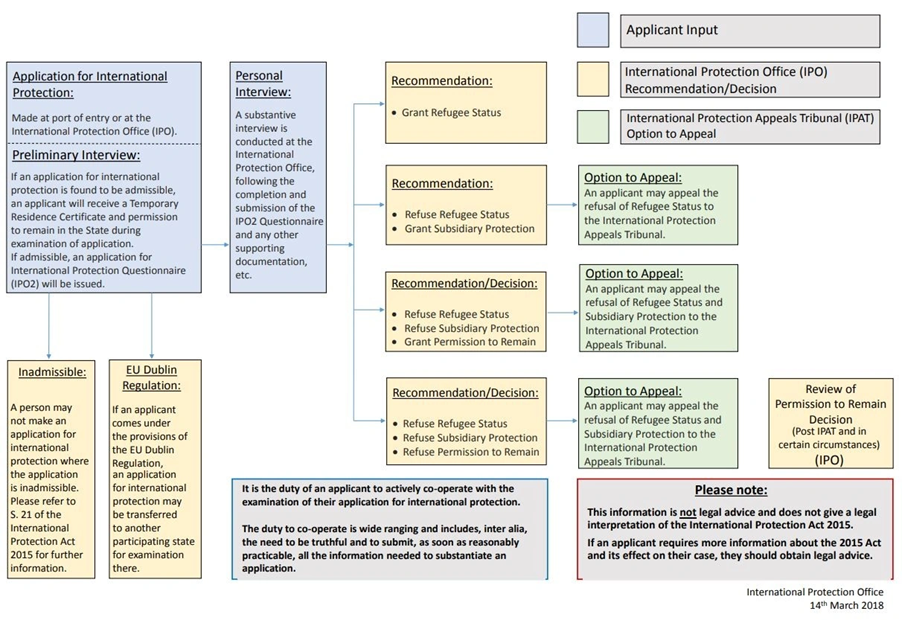
Making an application
Responsible authority and place
Applications for international protection can be made (in the sense of initial expression of the wish to receive international protection) at the airport/seaport (to Garda National Immigration Bureau or Border Management Unit) or within the territory of the country at one of the International Protection Office (IPO) locations in Dublin.
If a person is in a detention facility, the detainee will make their application by informing the prison governor of their intention to apply for international protection. The prison contacts a dedicated inbox at the IPO. A VC interview is scheduled with so that the application can be registered. The applicant is then released to lodge their application to include biometrics.
Where the detainee is imprisoned on criminal grounds, the full process is carried out using VC interviews
If the foreigner expresses his/her initial wish to receive international protection not to the authority competent to register applications (i.e. IPO), the application is forwarded to the Office ex officio.
Possibility to apply from outside the territory
All applications need to be made in person. Applications cannot be made to an Irish embassy abroad. Ireland does not have a scheme for issuing entry visas for humanitarian reasons.
Formal requirements for making an application
All applications need to be made in person at IPO offices. The IPO operates a Digital First policy utilising technological solutions where possible.
In July 2024, the IPO moved to fully digital application form which is completed with the assistance of an interpreter or cultural mediator.
The application is then reviewed by a floor manager before submission to ensure that accurate data is captured. The application then proceeds to biometrics and TRC issuance.
Registering an application
Responsible authority and place
The responsibility for registering an application for international protection lies with the International Protection Office. If the applicant is detained or in prison, they may submit their request for an application to the IPO through the prison authorities.
Practical steps to register the application
According to Article 13 of the International Protection Act 2015, to register their application officially, individuals seeking international protection are asked to go through a preliminary interview and complete a short application form, which will include consideration of whether or not their application is admissible or can be accepted by the IPO. If a person is detained, the interview takes place remotely via video conference. When necessary, the interview is conducted with the help of an interpreter.
According to Article 13 of the International Protection Act 2015, The Preliminary Interview is conducted so as to establish:
- whether the person wishes to make an application for international protection and, if he or she does so wish, the general grounds on which the application is based,
- the identity of the person,
- the nationality of the person,
- the country of origin of the person,
- the route travelled by the person to the State, the means of transport used and details of any person who assisted the person in travelling to the State,
- the reason why the person came to the State,
- the legal basis for the entry into or presence in the State of the person, and
- whether the application is inadmissible (first country of asylum)
Applications are registered in the Asylum and Immigration Strategic Integration Programme (AISIP) which is managed by Immigration Service Delivery, a dedicated unit within the Department of Justice, Home Affairs and Migration.
Individuals who have made an application at a border point are asked to present at the offices of IPO to officially register their application. Individuals who have not applied at the border points need to present at the IPO office as soon as possible, as any undue delay may prejudice their application. If the application is made directly to the IPO it is registered on the same day. If it is made to border guards, then it is registered on the same day or, if this is not possible, as soon as possible.
The start of the procedure for considering applications for international protection begins once an application is registered at IPO.
Data collection
A record of the preliminary interview is kept by the officer conducting it and a copy of it is furnished to the person and, if the preliminary interview was conducted by an immigration officer who is not an officer of the Minister, to the Minister.
At that time, an applicant’s biometric information (fingerprints) is taken and entered into the EURODAC database. If an applicant refuses to be fingerprinted s/he may be deemed not to have made a reasonable effort to establish her/his true identity and to have failed to cooperate.
The presence of the minor is required, and for children over 14 a photograph and fingerprints are taken by authorities. Fingerprints are not taken from anyone under the age of 14 by the IPO.
The Eurodac Regulation (604/2013), Article 9 obliges Member States to promptly take fingerprints of all fingers of every applicant for international protection who is at least 14 years of age. The new Eurodac Regulation (2024/1358), Article 15 obliges Member States to take the biometric data of every applicant for international protection who is at least 6 years of age.
Documentation
At the end of this first interview, individuals seeking protection are given the IPO2 questionnaire which will be completed in English. It is generally completed on the day with the assistance of a cultural mediator/interpreter where required. This is an administrative deadline and flexibility may be given to applicants requiring more time. Upon receiving this second, more detailed application, IPO communicates to applicants the date for their ‘substantive’ interview. A substantive interview may be scheduled for a date a number of months away for a “standard” applicant, while applicants from “accelerated” countries are prioritised in line with Section 72/73 of the International Protection Act 2015 and are given an interview within 4 weeks of their application.
Lodging of an application
Responsible authority and place
The lodging procedure overlaps with the registration of the application and is carried out by the same authority (IPO). Applicants must lodge their application in person at one of the two IPO locations in Dublin. The applicant is deemed to also have made an application for international protection on behalf of his or her dependent child where the child is not an Irish citizen and
- at the time of the making of the application by the person, is present in the State and has not attained the age of 18 years,
- is born in the State while the person is an applicant, or
- not having attained the age of 18 years, enters the State while the person is an applicant.
There is no separate right for accompanied children to apply for asylum independently even if they have different protection grounds to their parents, unless the parent(s) application have been concluded.
Formal requirements to lodge an application for international protection
After conducting the preliminary interview, applicants are given a detailed application form (IPO 2) which is completed on the same date unless there are exceptional circumstances such as unavailability of interpretation or an applicant’s vulnerabilities preventing the making of an application. In these scenarios, applications are facilitated as soon as possible
The preliminary interview form is filled out by the official who conducts the interview. Applicants are asked to fill out the IPO 2 form themselves. The application form comprises sections pertaining to the applicant's basic personal information; family information; information on identity documents and travel documents; applicant's testimony to establish a basis for the claim of protection; possible prior applications to other countries; and information pertaining to possible applications for family reunification and permission to remain. Throughout the process, applicants may also receive assistance by representatives of NGOs and, if applicable, by a legal guardian or legal representative.
Practical arrangements in place to assist a person in the lodging of an application include a specialised reception unit within the Office, provision of interpretation services, application for social supports, vulnerability assessment, medical assessment where necessary and transportation to and from the centre of accommodation.
Documentation
The applicant is issued a Temporary Residence Certificate and referred to the International Protection Accommodation Services (IPAS) for accommodation if they have no other means of accommodating themselves.
The Minister, as soon as practicable after receipt by him or her of an application, gives or causes to be given to the applicant a statement in writing specifying, in a language that the applicant may reasonably be supposed to understand:
- the procedures to be followed in the examination of applications for international protection,
- the entitlement of the applicant, for the purposes of their application, to consult a legal representative,
- the entitlement of the applicant to be provided with the services of an interpreter,
- the entitlement of the applicant to make, in writing to the Minister, submissions in relation to their application,
- the duty of the applicant to co-operate in relation to their application,
- the obligations of the applicant to comply with the Permission to enter and remain in the State
- the possible consequences of the failure of the applicant to attend a personal interview, or to comply their obligations.
Information provision
As soon as they express their intention to apply for international protection, applicants are informed by immigration officers about their right to apply and that they are entitled to consult a solicitor, as well as the UN High Commissioner for Refugees. When possible, this information is communicated to applicants in a language they understand - if needed through a phone call with an interpreter. The website of the International Protection Office: http://ipo.gov.ie/ contains information on the procedure.
Information is also delivered electronically through the IPO Portal. Upon registration, applicants are provided with rights and obligations to read before completing the application form.
A QR code is used to provide a link to the applicant’s handbook which is available in a range of languages via the IPO website. The QR code is also included with the copy of the application form emailed to the applicant once their application is lodged.
When in detention, people are also informed by immigration officers about: the reason for their detention; the court process for determining whether they should stay detained or be released; their right to consult a solicitor and notify the High Commissioner of the detention; their right to leave the state at any time; and their right to receive the assistance of an interpreter. Representatives of IPO, who visit places of detention to process applications, bring an interpreter in the applicant’s chosen language, if available.
Passport and other documents
Obligation to surrender original documents
Requirement to submit original documents
The International Protection Act 2015, Section 27(1)(a) states that “It shall be the duty of an applicant to submit as soon as reasonably practicable all the information needed to substantiate his or her application”. Section 27(2) of the Act states that the “information referred to in Sub-section (1) consists of statements by the applicant, and all documentation at their disposal regarding the elements referred to in Section 28(3) of his or her application.”
It is preferable that original documentation is submitted. However, photocopies are accepted. Nonetheless, a photocopied identity document/passport will not be considered as proof of nationality in isolation.
Consequence of a refusal to surrender documents
Article 27 of the International Protection Act provides for the duty of cooperate of an applicant, in for international protection. Where an applicant does not cooperate, as provided by Article 38 of the International Protection Act, the asylum application may be dismissed.
Return of original documents to the applicant
An applicant cannot request their national passports back while the asylum process is still ongoing. All documents submitted by applicants are retained pending final determination of an application by the Minister. Copies of any such documents are provided on request together with a letter confirming that the originals are held on file at the International Protection Office. An applicant can request the temporary return of an original document, in writing, stating the purpose for which the document is required, e.g. registration and/or obtaining marriage/birth certificate, driving licence, work permit etc. The request is then considered by the International Protection Office.
Other documents
Information is currently not available.
Requirement to read digital data
Information is currently not available.
Guarantees for applicants
Confidentiality principle
Article 26 of the International Protection Act 2015 covers the protection of identity of applicant. The Minister and Tribunal shall take all steps to ensure that the identity of an applicant is kept confidential.
Article 35 of the International Protection Act provides the appropriate confidentiality during the personal interview at first instance and the same applies for the preliminary interview during the registration procedure.
Information provision
As soon as they express their intention to apply for international protection, applicants are informed by immigration officers about their right to apply and that they are entitled to consult a solicitor, as well as the UN High Commissioner for Refugees. When possible, this information is communicated to applicants in a language they understand - if needed through a phone call with an interpreter. The website of the International Protection Office contains information on the procedure.
Information is also delivered electronically through the IPO Portal. Upon registration, applicants are provided with rights and obligations to read before completing the application form.
A QR code is used to provide a link to the applicant’s handbook which is available in a range of languages via the IPO website. The QR code is also included with the copy of the application form emailed to the applicant once their application is lodged.
When in detention, people are also informed by immigration officers about: the reason for their detention; the court process for determining whether they should stay detained or be released; their right to consult a solicitor and notify the High Commissioner of the detention; their right to leave the state at any time; and their right to receive the assistance of an interpreter. Representatives of IPO, who visit places of detention to process applications, bring an interpreter in the applicant’s chosen language, if available.
Upon receiving an application, the IPO should give applicants a statement in writing and in a language, they may be reasonably expected to understand, informing them about:
- The procedures for the assessment of their application;
- The rights and the obligations;
- Their right to consult a solicitor;
- Their right to receive the service of an interpreter;
- Their right to make written submissions to the International Protection Office in regards to their application
- Their obligation to cooperate with immigration authorities and provide needed information, as well as their obligation to comply with the rules pertaining to their entry and stay in the state and the possible consequences of non-compliance with these rules;
- The possible consequences of a failure to attend their personal interview with IPO and of not complying with the obligations to cooperate with the authorities;
- The time-frame of the procedures;
- The means at his/her disposal for submitting the elements needed to substantiate the application;
- The consequences of an explicit or implicit withdrawal.
- Format to provide information on making, registration and lodging may be leaflet/brochure and individual sessions may be conducted or required by the applicant.
In addition, all applicants are provided with the Information Booklet for Applicants for International Protection, published by the Reception Unit of the IPO, which provides information on the international protection process in Ireland, and explains applicants' rights and obligations throughout the process. The booklet is available in 21 languages.
A separate booklet, produced by the European Commission is provided to individuals who are subject to the Dublin procedure. The booklet is a guide to the Dublin process in general.
The International Protection Office has published 4 Addendum to the Information Booklet for Applicants, providing information about the effects of the International Protection Act 2015 including safe list of countries of origin and permission to remain. The latest 4th Addendum includes information regarding the timing of the prohibition of Refoulement consideration under section 50 of the International Protection Act 2015
Finally, another Booklet targeting specifically UAMs/separated children is also available in 9 languages.
Unaccompanied children apply through TUSLA (State agency responsible for child protection and welfare services) and are assigned a dedicated social worker. There is child specific information available from the IPO when making an application if it is deemed to be in the best interest of the child to do so.
During this initial appointment with the IPO, applicants are also informed that they may seek legal advice from the Refugee Legal Service, within the Legal Aid Board. The contact details of the Board, as well as of other relevant bodies that may assist applicants in the process, is also included in the Information Booklet for Applicants for International Protection.
Authority/agency: International Protection Office Title: Information Booklet for Applicants for International Protection Type: Leaflet Hyperlink: https://www.ipo.gov.ie/en/IPO/IPO%20English%20Information%20Booklet%20Final%20.pdf/Files/IPO%20English%20Information%20Booklet%20Final%20.pdf (available in 21 languages) |
Authority/Agency: European Commission Title: “I’m in the Dublin procedure – what does this mean?” Type: Booklet |
Authority/Agency: International Protection Office Title: Information regarding the timing of the prohibition of Refoulement consideration under section 50 of the International Protection Act 2015 Type: Leaflet Hyperlink: http://www.ipo.gov.ie/en/IPO/PRInformationBookletEnglish.pdf/Files/PRInformationBookletEnglish.pdf |
Authority/Agency: Legal Aid Board Title: Civil Legal Aid and Advice for International Protection Cases Type: Website |
Interpretation
During the preliminary interview, whether at a detention facility, border-crossing point and borders or at IPO premises, the preliminary interview may be conducted with the assistance of an interpreter if necessary (Article 13(3) of the International Protection Act)
As outlined in article 18 of the International Protection Act, the Minister shall inform in a language the applicant may be supposed to understand the information on procedure, rights and obligations, including the provision of interpretation services.
Legal assistance and representation
According to article 18 of the International Protection Act, the Minister shall inform in a language the applicant may be supposed to understand the information on procedure, rights and obligations, including the provision of legal assistance and representation. During the making, registering and lodging process, IPO officials advise applicants to contact the Legal Aid Board.
An application form and associated consent form must be filled out and returned to one of the Law Centres. Applicants are generally required to contribute towards the cost of the legal service. This is typically a €10 contribution for asylum seekers.
However, if the applicant can demonstrate that they are in financial difficulty (e.g., they have no income, are unable to meet basic living expenses, or are in a particularly vulnerable situation), they can ask the Law Centre or the Legal Aid Board to waive this small fee.
Additionally, the Irish Refugee Council provides information on how to apply for legal aid.