

In fulfilling its role and functions relating to situational awareness (Article 5 and 6 of the EUAA Regulation), the EUAA follows strategic objectives in its research methodology. These include gathering information according to quality standards used across the EUAA based on relevance, reliability, objectivity, completeness, accuracy, currency, traceability and transparency. The EUAA aims to gather and analyse diverse information from a variety of sources and stakeholders to offer a comprehensive and balanced perspective, and an objective overview and analysis of the functioning of the Common European Asylum System (CEAS) at the national and European levels.
This approach is applied across the situational awareness publications and products which are developed, including the Asylum Report and accompanying resources, situational updates, and the EUAA Case Law Database and its ancillary products.
Information on the EUAA Database on International Protection in Europe (DIP) is collected through targeted desk research and engagement with relevant stakeholders. Sources of information are categorised into two types: (1) national authorities of EU+ countries, and (2) complementary sources.
(1) National authorities of EU+ countries include asylum and reception authorities, ombudspersons and other relevant national bodies.
(2) Complementary sources include:
- International organisations and inter-governmental processes (e.g. UNHCR, IOM, Council of Europe treaty bodies);
- Courts and tribunals (by documenting decisions and judgments);
- Other public sources including civil society organisations (CSOs), think tanks, and academia, referring to their reports, press releases, open letters, submissions to institutions and public statements.
- Exceptionally, media sources used to report on certain developments if information cannot be obtained from other sources or when national administrations use the media to make public statements. Preferably media sources are accompanied by other official sources.
The information collected is based on robust methodology in line with the EUAA’s role as a centre of expertise on asylum. Information in the database is presented in a balanced manner with the aim of reflecting the perspectives of all relevant stakeholders in the EU+ countries.
Thematic information by country
The country pages include information on 13 thematic areas in asylum and reception. The page structure is the same for all countries to ensure comparability. The information is descriptive and does not assess national policies and practices in the field of asylum. Information in the thematic pages is primarily sourced from legislation, official documentation produced by national authorities (reports, policies, websites, statements etc.), as well as information provided to the EUAA by national authorities.
Information from civil society organisations (CSOs) may be used in thematic pages where information from national authorities is not made available, or to support information obtained from national administrations, or to provide contextual information on the practical functioning of the system. Information expressing assessments or views about the implementation of CEAS in the national context is not included in the thematic pages. Information from CSOs is not used to offer an evaluation against the standards of CEAS (as this is not the purpose of DIP). Such information may be included in the Recent developments timeline which documents publicly available information from various sources, including CSOs.
Review of thematic information
The EUAA conducts desk research throughout the year to update the information in the thematic country pages. National administrations verify the accuracy of the information through a validation process within a defined 9-week timeline. Disclaimers on a thematic page notify users when content is undergoing a review and validation process, and when content has been validated.
Regular validation cycles are crucial to reflect the current state of play within dynamic national contexts. The validation process enables national administrations to comment, clarify or add information prior to it being published. In this respect, the EUAA and national administrations share the task of keeping DIP up to date: the EUAA conducts continuous desk research to update information and developments in DIP, and national administrations verify the accuracy of the thematic information through the validation process. Changes suggested by national administrations are reviewed by the EUAA before they are published. This process ensures that the information in the database is of high quality, accurate and up to date. For a visual representation of how the validation process works, see here:
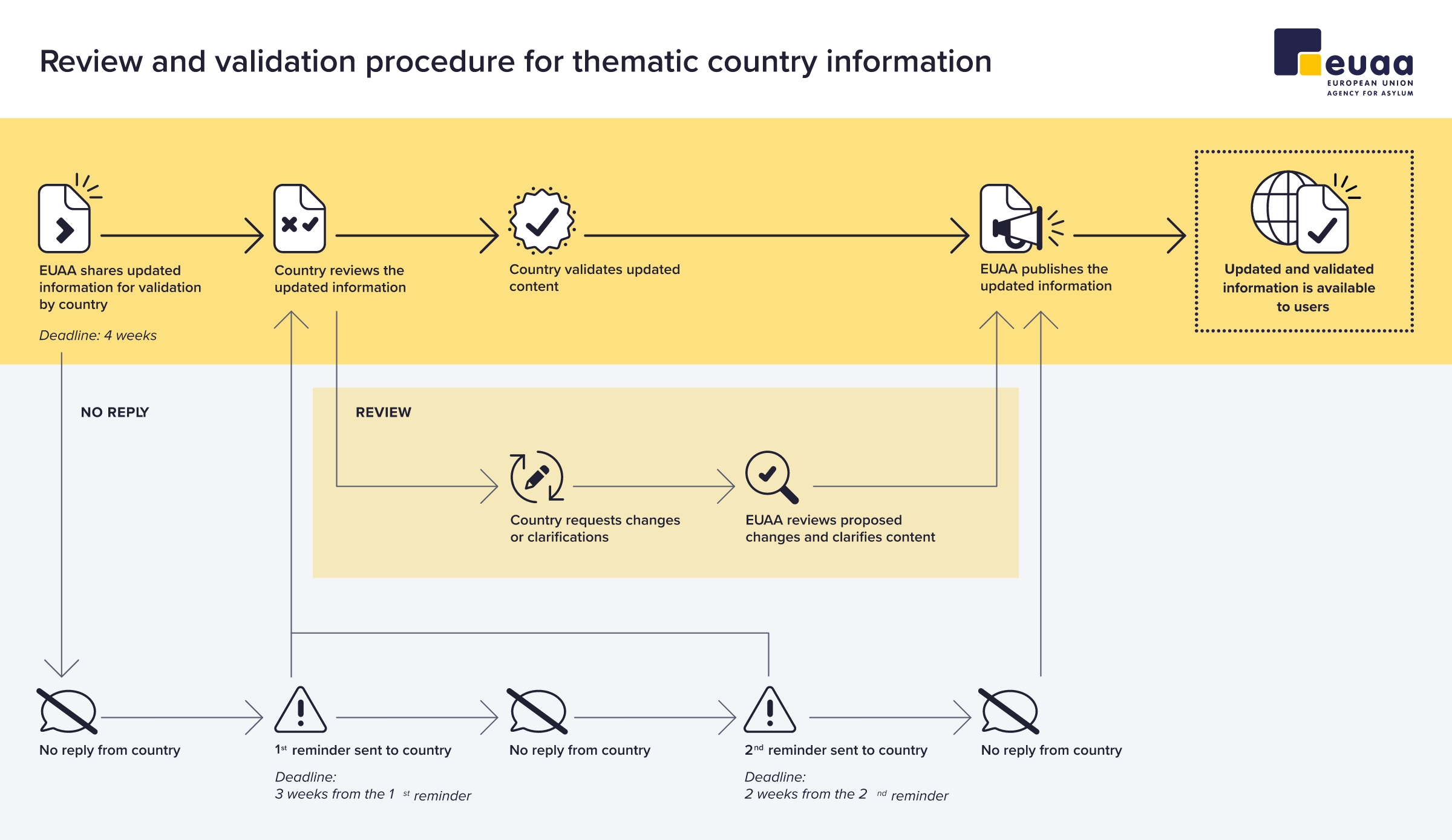
.
Recent developments timeline
The Recent developments page displays information along an interactive timeline documenting developments in asylum and reception, including events, publications, policy announcements, legislative changes etc. Developments are gathered from a variety of other publicly available sources compiled together with information published by national administrations, international organisations, CSOs, academia, think thanks and media (only in very exceptional cases) to provide a general picture of the situation of asylum and reception in EU+ countries, including legislative, policy and practical changes as well as challenges, events and issues. This information is listed in chronological order and the scope of this section is to supplement information included in the thematic pages. This information is not subject to a review and validation process by national administrations.
Information from complementary sources
Information from complementary sources refers to publicly available information from EU institutions and agencies, international/regional organisations, civil society organisations (CSOs), and other relevant actors (e.g. academia and think tanks) on developments in asylum law, policy and practices. Such information comprises of publications (reports, articles, press releases, open letters, submissions to institutions, statements) and any other information that is documented and in the public domain.
Preamble 40 of the EUAA Regulation states that the Agency should maintain a close dialogue with civil society organisations with a view to exchanging information and pooling knowledge in the field of asylum. Article 5(2) states that, in addition to information from Member States, EU institutions and UNHCR, the Agency may also take into account information available from relevant organisations on the basis of their expertise.
In terms of Article 50 of the EUAA Regulation, the EUAA also engages with relevant CSOs in the context of exchanging information and the sharing of knowledge with the Consultative Forum. Article 2(a) states that the EUAA shall, in particular, make use of all relevant sources of information, including from members of the Consultative Forum. Furthermore, in fulfilling its functions relating to situational awareness, the EUAA engages with a network of CSOs beyond the Consultative Forum. This offers the possibility to engage in dialogue with CSOs on the content of their publications and the methodologies used, and to further increase the pool of sources.
Assessing expertise and selecting complementary sources
Complementary sources may provide information that can be relevant to CEAS. This means that sources should not be excluded without further consideration and assessment.
Source assessment is the process of thoroughly and critically evaluating a source against the mentioned quality standards by asking the following questions (and which are also used in other EUAA methodologies):
- Who is providing the information? Is this clear or the source anonymous? What is their reputation? Does the source have specific knowledge that makes them an expert on the issue at hand? Does the source have a known bias? What is the context in which the source operates?
- What information is provided? What is the real content/substance of the information produced? To what extent is it fact-based and documented? Is it delivered independently of the motivation of the source?
- Why are they providing this information? What is the agenda or mandate of the source? Does the source have a specific interest?
- How is the information presented? How is it formulated? Is the material presented in an objective and transparent way? Is it clear what methodologies are used? How is the information gathered by the source?
- When was the information gathered and when was it provided?
In assessing the expertise of complementary sources, CSOs in particular, for the purposes of gathering information for DIP, the following additional elements are also considered:
- History: How long has the source been in existence and engaging within the national context?
- Reputation: What is the reputation of the source and how is it viewed by practitioners and experts in the field, including national administrations? Based on its history, are there any known issues with the credibility of information shared by the source?
- Competence in asylum and reception: What is its stated mission and aim, as well as its technical expertise on the topic?
- Modus operandi: Whether it is an advocacy-based or operational organisations, the information is weighted based on its stated advocacy role and the objective pursued, the activities conducted, and the methodology used.
Verification and assessment of information for DIP
For the purposes of the verification and assessment of information for DIP, the following considerations are taken into account:
- Publicly available information - Is the information publicly available? Information from complementary sources must be publicly available, and the source clearly identified and appropriately referenced. Information provided to the EUAA in an unofficial, informal or non-public manner is not included in the database. For example, information provided to the EUAA in meetings or verbal exchanges, and which is not publicly documented (and therefore cannot be referenced) is not used.
- Validation workflow for thematic pages - For the specific thematic areas/country pages of DIP (for example, the description of the procedural and administrative steps in the asylum registration procedure), information will be primarily sourced from national administrations. In some cases and specific contexts, information may be gathered from CSO sources to supplement that of national administrations. The information will be fact-checked in cooperation with national administrations through the validation process.
- Fact-checking and corroboration of information for the Recent Developments timeline - For the purposes of the Recent Developments timeline, a fact-check by the EUAA, in cooperation with EU+ countries when and where relevant, is conducted by verifying whether information published by other sources is accurate to the extent possible, based on publicly available information and generally known facts. In situations where conducting a fact-check is not possible (due to the lack of other corroborating information from a different source, for example), then this shall be reflected in the way the information is presented on the platform by clearly attributing statements and positions to those who made them. Furthermore, situations where information from complementary sources cannot be corroborated or fact-checked will be assessed on a case-by-case basis and a general disclaimer is included on the website that any statement made by a source and referenced on the platform does not imply endorsement by the EUAA.
- Incorrect information or inaccuracies on repeated occasions – Where complementary sources are noted to publish incorrect or inaccurate information on repeated occasions over a period of time, the EUAA will consider excluding them from the pool of sources.
Presenting an objective and balanced picture of CEAS implementation
DIP seeks to present an objective and balanced picture of the implementation of CEAS by gathering information from a variety of sources using the principles of openness, transparency and convergence towards common standards. Without these elements, bridging information gaps and balancing the integration of all voices and perspectives is not possible.
To adopt an open and transparent approach and ensure that DIP becomes a trusted public source of information on all matters relating to the implementation of CEAS, the EUAA adopts the following considerations:
- Transparency and integrity: the EUAA publishes its methodology for populating the database with thematic content and for including information from complementary sources describing recent developments in the field of asylum and reception. Sources are used and referenced throughout the database. Furthermore, the methodology for selecting information from complementary sources, and verifying and assessing such information is also communicated in a clear manner to all stakeholders participating in relevant consultation processes.
- Clearly distinguishing the source: All sources of information, whether they are national administrations, national ombudspersons and monitoring bodies, international organisations, treaty bodies or CSOs, are clearly distinguished, and there is a clear demarcation (in the use of language and also using visual cues) between information provided by authorities and information retrieved from complementary source reporting. In all posts relating to recent developments, there is a clear identification of who said what and in what context.
- Information to be published in a complete manner: When there seems to be conflicting information on a specific matter or event after verifying the sources, the EUAA consults national administrations for their comments on the information which appears to be contradictory. Information which is assessed by the EUAA to be incorrect or inaccurate after an analysis of the content is not published. However, relevant and contradictory information on a certain subject is included in the platform, while explicitly highlighting the contradiction in order to assist the target audience in assigning weight to such information. This is in line with existing EUAA methodologies.
- Standardisation of language – Due to its public nature, DIP is accessible to an audience which may not necessarily have asylum and reception expertise. In this sense, every effort is made to ensure that the language used to describe technical issues and areas is standardised to minimise the risk of misunderstandings and misinterpretations. In addition, every effort is made to ensure that the database is user-friendly and provides a visually clear distinction between the various sources of information.
Disclaimers
- The European Union Agency for Asylum (EUAA) maintains this website to enhance public access to information related to its activities, and to information in the field of asylum and international protection.
- The European Union Agency for Asylum (EUAA) aims at offering accurate, high quality and up to date information. However, this information is of a general nature and is not intended to address the specific circumstances of any particular individual or entity, nor is it intended as a professional or legal advice.
- Neither the European Union Agency for Asylum (EUAA) nor any person acting on behalf of the EUAA is responsible for the use that might be made of the information contained within this database.
- Reproduction is authorised provided the source is acknowledged. For any use or reproduction of photos or other material that is not under the EUAA copyright, permission must be sought directly from the copyright holders.
- The reporting on national practices, activities, recommendations, statements, opinions and positions does not imply endorsement on the part of the European Union Agency for Asylum (EUAA). Due to the continuously changing situation, the information described may have changed or been updated by the time of publication. Please consult the original sources for the latest developments and information.
- The European Union Agency for Asylum (EUAA) website provides links to third-party websites. Since we do not manage these websites, we encourage you to review their privacy policies.
- The European Union Agency for Asylum (EUAA) is not in a position to fact-check positions and/or opinions expressed by sources cited and documented on the database.
- Please note that it cannot be guaranteed that a document available online exactly reproduces an officially adopted text. Only European Union legislation published in paper editions of the Official Journal of the European Union is deemed authentic.
- The European Union Agency for Asylum (EUAA) does not have powers on individual applications for international protection, which are analysed and decided by the Member States' asylum authorities.
- Our goal is to minimise disruption caused by technical errors. However some data or information on our site may have been created or structured in files or formats that are not error-free and we cannot guarantee that our service will not be interrupted or otherwise affected by such problems. EUAA accepts no responsibility with regard to such problems incurred as a result of using this site or any linked external sites.
- This disclaimer is not intended to limit EUAA's liability in contravention of any requirements laid down in applicable national law nor to exclude its liability for matters which may not be excluded under that law.